The speed of my blogwriting has recently been
slower due to an increased amount of work. The culmination of it was when I was
preparing for the summer camp for local high school students. The iChange
Summer Camp that the AIESECers along with interns organized managed to attract
80 students and offer them a 3 days of workshops and activities.
 |
| A lot of black hair |
 |
| Two local girls with an Indonesian intern |
 |
| Local girls with a Chinese intern |
 |
The intimate game where chairs are being removed from under the circle of
people and the team that manages to keep the position the longest wins. |
The 3 days taught me a lot about the younger generation. Although the students
there were mainly from schools for the talented (where they teach English,
other humanities and natural sciences in depth to brighter students), the
youngsters left a good impression as avid listeners. They were veery attentive
during the sexual education workshop, as this is a very tender topic for them.
The students were aged 15-18, but:
1)…they had never (!) had sexual education
lessons at school
2)…most of them had never kissed before (they were
surprisingly open about this topic even in front of others) and laughed at the
idea of them buying condoms.
3)…knew very well that if gender and sex are in conflict (hence if one is
biologically a man for example but feels oneself as a woman) then what do they
do: they go to Thailand.
Besides the educative workshops (the topic of
public speaking and the problems of street children) there was much dancing and
many games. That gave me another insight into the students’ “likes”:
·
They love (dirty) dancing. When pop songs
were played, they all went wild and congregated into a huge circle, in the
middle of which groups of 2 or bigger show-offs paraded their moves. Some girls
also “got low”. In such a sexually conservative society this is surprising. But
I guess influences of pop culture have taken over.
·
They reaaallly love the U.S. For example,
we had an event called Global Village, where every intern was supposed to make
a poster, collect souvenirs as well as other symbolical items and present their
country. Every intern had weeks to prepare for their booth (the Czech Republic,
Malaysia, Hong Kong, China along with Uzbekistan, Tajikistan, Russia and
England, Canada, Germany, France, Indonesia and Estonia), but the intern from
the U.S. had just a day to hastily put something together. The result was a
small collection of American books, a flag and some pictures (everything you
can get in a short amount of time), whereas for example China had loads of
souvenirs, interns dressed in traditional dresses, treats, and much aesthetical
pleasure. In the voting round, where students picked out their favourite booth
and country, they unanimously chose the U.S. Despite all the negativity towards
the country conveyed in hisorical texts, the older generation (especially
evident in Saigon’s War Remnants Museum) the youngsters have embraced the U.S. Many
of them that I talked to about future plans expressed that they want to study
there. They had brilliant English, some even corrected the interns’ grammatical
mistakes. Many were taking IELTS classes for the 2nd and 3rd
year. Their English was, at times, much better than the local university
students’.
·
Karaoke is life. It is not unusual for
somebody to walk around and pretend that he/she is a jukebox. And most of the
people I’ve heard doing that are quite good artists of imitation.
 |
Explaining the ladder model of sexual development. I let the students
choose the appropriate pictures for each step. |
 |
| Presenting: Estonia |
 |
Who am I really ?
Thank you SCORA for this fabulous game idea ! |
There are other characteristcs inherent to the
older generations though. They seem to have a flipside – something that hey
don’t express unless their profit is jeaopardized. At firtst people seem kind
and hospitable, but as soon as you raise issues of money, they start to express
the sinister side. This is most evident on the market, where everybody seems to
try to rip you off with alien prices (for example, would you pay 1,75 EUR for 2
oranges or 2 EUR for an apple?). A fellow intern has also started to question
the hospitality of her host family, who seem to not want to eat together with
her, but are keen on making a business out of making the few meals that they do
provide for her.
By now I’ve also witnessed something astounding about some of the elderly Vietnamese. As Kelly and I drove towards the Mekong River Delta with a tour bus, we saw the remains of a recently occurred accident on the road – a woman and a little boy lying on the ground almost 20 metres away from their motorbike, with their internal organs in places you woulnd’t normally see them. Our bus driver had jollily laughed the whole way there about something that the tour guide told him in Vietnamese, and seeing the macabre scene of the accident didn’t stop him. Perhaps it’s the influence of buddhism that makes people overlook the tragedy of dying ? Or were they just a couple of cold-hearted guys ? The tour guide later said smth like “the population of Vietname is so big (approximately 91,52 million - wikipedia estimate), so don’t worry. Many (approx. 12 800 people in the year 2007 - WHO estimate) die in traffic accidents every year. “ Motorbikes really are a gateway to death if you think of it: no seatbelts (which would make matters much worse in the case due to the weight of the bike), nothing to protect you from flying away into great distances, 2 wheels (balance is easily lost in the case of a blow). Every motorbike driver here depends on their reflex speed, agility and instincts. Despite existence of a traffic law (which seems much more vague that for example the Estonian one), nobody seems to turn much attention to the rules. There are tens of millions of motorbike drivers in Vietnam. Accidents are not only likely, but they are a reality.
Despite the occasional blowbacks of and
discoveries about local conditions, there is still much here to cheer one up. For example, there is Cholon, the Chinese district of Saigon.
 |
The guy on the right has a true "Mind your own business, sonny." I guess me
taking the picture did come quite come quite unexpected for him. |
 |
A pagoda in Cholon: incense, incense and incense.
the things hanging from the ceiling are also candles) |
 |
| Happily working at the market |
 |
| Cool cyclo driver |
 |
| In another pagoda in Cholon |
 |
| A shabby apartment building |
 |
These leaflets were hanging on a wall in the pagoda. They signify donations
made to the pagoda by various people. |
 |
| A closer look at the some incense candles |
 |
| Saigon |
The latest energising experience came from the Mekong River Delta . As
backround knowledge, it is:
- ·
in the very south of Vietnam, where the
river spreads into a maze of canals (some of which are artificial)
- ·
a rural area. However, when driving out
of the few bigger cities, the roadsides are still packed with houses for
hundreds of kilometres. This means every hectare of fertile land is exploited.
- ·
the main producer of rice and noodles for
Vietnam. For example, one noodle factory that I visited produced 500 kg of
noodles (made out of rice) per day with just a few pairs of hands. 1 kg of
noodles costs 0.75 EUR.
As for the trip itsself, I’ll let the pictures
do the talking.
 |
| Add caption |
 |
| Child sending kisses from a boat on Cai Rang floating market |
 |
| Petrol is everywhere |
 |
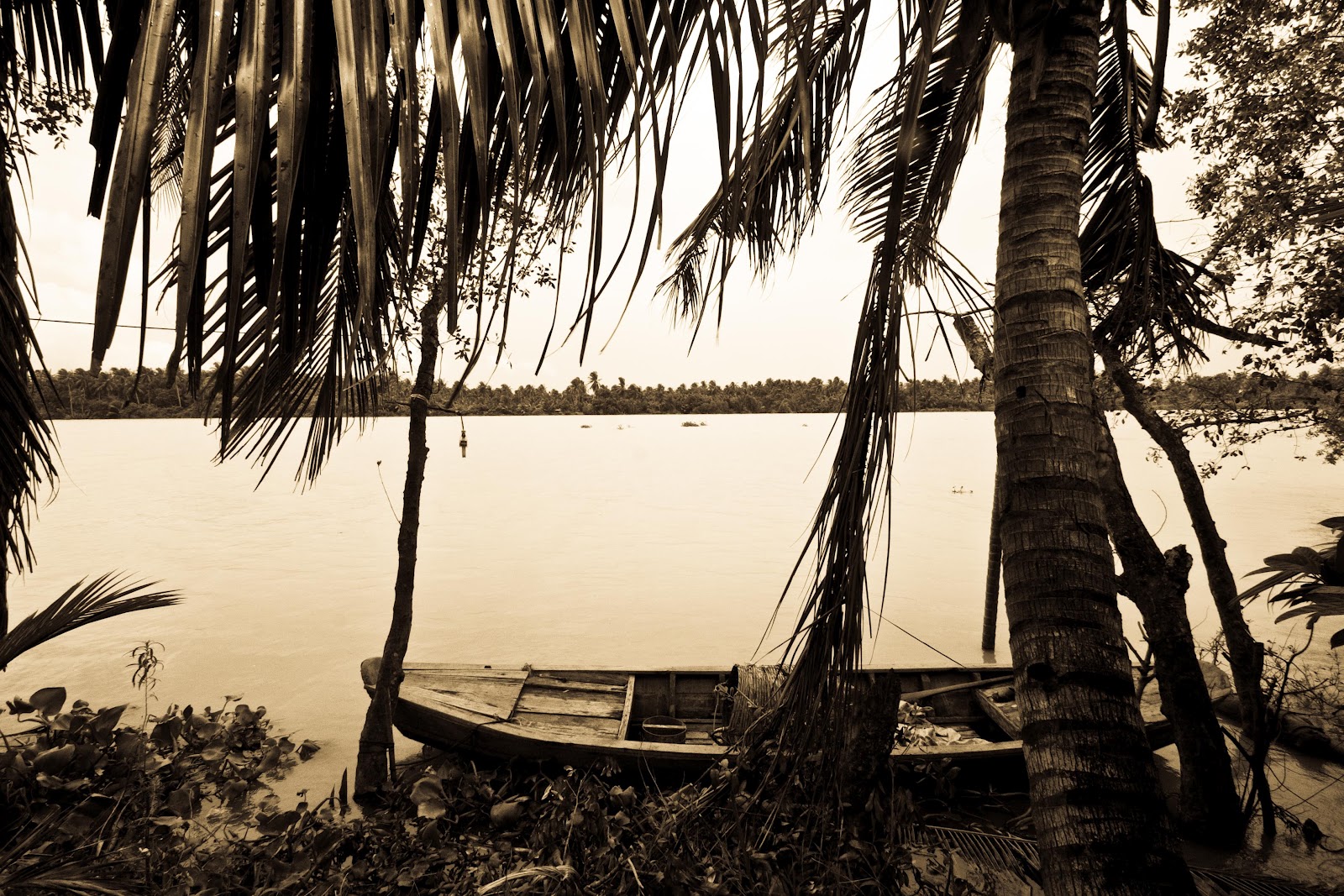
| On the Mekong River near the city of Can Tho |
 |
| Everyone who lives on or near the river washes their belongings in the river. Some also was themselves there. |
 |
| Floating cafe |
 |
| Cai Rang floating market |
 |
Parking lot.
|
 |
Coconut juice is a regular drink here. You need to have a raw-looking coconut,
for the drink, because if you devour a more ripe one, you might have stomach
problems later. |
 |
| Nearly every boat rower in the Mekong River Delta's tourist industry is a woman. They are incredibly precise and enduring in rowing those boats. |
 |
| Add caption |
 |
| Add caption |
 |
| My favorite local fruit - the dragonfruit. It's insides is very juicy and mildly sweet with numerous edible little seeds. |
 |
| Add caption |
 |
One of the first steps of making a coconut candy. The coconut candy is a very
chewy and sweet candy that comes in many flavors - coconut and either durian/
chocolate/peanut. In this step, the coconut milk is mixed with starch and
boiled in a cattle. |
 |
| The next step: boiling and rapid stirring to create more chewiness |
 |
| Poor crocodiles |
 |
| In a factory that produces honey |
 |
Me and my mighty friend, the python.
|